

Is the Canon EOS Rebel T7 still worth buying? Yes, but only if you want a low-cost first DSLR for family pictures, travel, portraits, landscapes, and learning the basics of photography. Its 24.1MP APS-C sensor still makes attractive images, and its simple controls, Wi-Fi, and broad EF/EF-S system make it more useful than its modest specification sheet suggests.
This Canon EOS Rebel T7 review does not suggest that the camera has kept pace with DSLR cameras. It has not. The nine-point AF system, 3 fps burst, fixed non-touch screen, and 1080p-only video are clear limits. Yet an affordable camera that teaches exposure, accepts useful prime and telephoto choices, and is easy to bring to a family event remains a good purchase.
Is the Canon EOS Rebel T7 still worth buying?

The Rebel T7 is worth buying for beginners, students, and families who can find it at a genuinely low price, preferably with the 18–55mm kit zoom. It is not the best beginner DSLR for fast sport, creator video, or low-light action, but it remains a capable first camera for people ready to learn rather than simply upgrade a phone.
What matters is price and expectation. At a low used or clearance price, it leaves money for an extra LP-E10 battery, an SD card, and one useful EF or EF-S choice. At a price close to a newer used Rebel SL3 or T8i, it becomes much harder to recommend. The EOS Rebel T7 / 2000D is a camera that succeeds by being simple.
Key specifications at a glance
- 24.1MP APS-C CMOS sensor
- DIGIC 4+ processor
- ISO 100–6400, expandable to 12,800
- Nine-point AF system with one center cross-type point
- 3 fps continuous shooting
- 3.0-inch fixed 920k-dot LCD with no touch control
- Pentamirror finder with about 95% coverage
- Full HD 1080p recording at 24p, 25p, or 30p; no 4K
- Built-in Wi-Fi and NFC; no Bluetooth
- One SD/SDHC/SDXC card slot
- LP-E10 battery, rated around 500 shots
- 475g body with battery and card
How does the Rebel T7 feel in everyday use?
The Canon EOS Rebel T7 feels light, straightforward, and unintimidating. It is designed for a person moving from phone pictures to a real camera, not for someone who expects dual dials, weather resistance, or a dense array of direct controls.
At 475g, the body is easy to carry through a day of sightseeing or a family gathering. The grip is modest but secure with the kit zoom and small prime choices. Add a large telephoto and the balance changes quickly, so the camera is best paired with compact EF-S options when comfort matters.
Canon’s menu system is one reason the T7 remains friendly to newcomers. Scene Intelligent Auto gives a reliable starting point, while Creative Auto explains changes in plain language before the user knows every technical term. Once you begin using aperture priority, shutter priority, and manual exposure, the camera does not get in the way. The rear buttons are simple, and the Quick menu provides access to common settings without a deep menu dive.
The fixed screen is the first reminder that the camera is an older entry body. You cannot tilt it for low-angle travel pictures or turn it toward yourself for a video introduction. It is also not touch-sensitive, so changes happen through buttons and the directional pad. That sounds slow at first, but it can actually make a beginner learn the camera more deliberately.
How good is the 24.1MP APS-C sensor?
The 24.1MP APS-C sensor is the Rebel T7’s enduring strength. In good light, it makes detailed photographs suitable for large prints, online portfolios, albums, and meaningful crops; it is dramatically more flexible than the sensor in older low-cost DSLRs.
For landscapes, use ISO 100, stop a suitable zoom down around f/8 to f/11, and take time with composition. The T7 can render foliage, buildings, water, and distant detail very well. At a family event outside, the camera gives you enough resolution to crop a child from a wider frame and still make a pleasing print.
Canon JPEG color is pleasant for people’s pictures. Skin tones generally need little work, and Auto Lighting Optimizer can help a JPEG retain some shadow detail in contrasty scenes. RAW capture gives more editing room, particularly when bright skies or dark interiors challenge exposure. A beginner does not need to start with RAW, but it is helpful to know the room exists when a photograph matters.
The sensor does not make the T7 a low-light miracle. ISO 1600 and 3200 can work nicely for indoor birthdays, dinners, and window-light portraits when you expose carefully. ISO 6400 is usable for smaller output and documentary moments, but fine detail falls away. The expanded ISO 12,800 setting is best reserved for a photograph that matters more than technical polish.
Is the Rebel T7 autofocus adequate?
The nine-point AF system is good enough for portraits, family photographs, travel, landscapes, and subjects moving at a predictable pace. It is not good enough to call the Rebel T7 a sports, wildlife, or action specialist.
The center cross-type point is the strongest choice. For a portrait, place it on the nearer eye, focus, and recompose carefully if the subject is not very close. This approach is slower than modern face recognition, but it teaches focus discipline. The outer points can work in good light, yet they are less dependable when a room becomes dim or a subject lacks contrast.
At 3 fps, burst shooting is limited. It can catch a few expressions during a birthday, a child blowing out candles, or a dog running across a garden if you time the moment well. It will not reliably cover a football match, birds in flight, or a rapidly changing dance floor. The buffer also encourages short, intentional bursts rather than holding the shutter down.
This limitation does not make the T7 a poor beginner camera. It simply makes it honest. Beginners often improve more from choosing a moment, anticipating movement, and working with one selected AF point than from spraying dozens of frames. If quick action is your priority, a used Canon 90D, Rebel T8i, or Nikon D3500 is a more suitable direction.
Is the screen and finder comfortable for learning?
The T7’s fixed 3-inch display and pentamirror finder are basic, but they are perfectly functional for learning photography. The display is clear enough to check composition and review images, while the finder encourages you to frame a scene without distractions.
The finder shows about 95% of the final frame, so a little more may appear in the final file than you saw while composing. This is normal at the entry level. Watch the edges when photographing distracting objects, and leave a small margin if precise framing matters.
The rear screen’s 920k-dot resolution is adequate for checking sharpness and exposure, though it is not a reliable substitute for evaluating every detail on a computer. Its lack of touch control and articulation is the T7’s largest usability disadvantage beside autofocus. A Rebel SL3 is much easier to use for low-angle flower shots, group pictures where you need to be in the frame, or overhead event shots.
Is the Canon EOS Rebel T7 decent for portraits and family photos?
The Rebel T7 is excellent for portraits and family photos when light is reasonable and you use a suitable fast prime choice. Its 24.1MP sensor, friendly Canon color, and simple operation help beginners capture moments rather than wrestle with settings.
For a child’s birthday indoors, set aperture priority, choose a bright prime option such as a 50mm f/1.8, use ISO 1600 to 3200, and keep an eye on shutter speed. The T7 will not track a child running straight toward the camera perfectly, but it can make warm, sharp images of candid laughter, cake cutting, and relatives gathered at a table.
Outdoors, the kit zoom is more flexible. Use the longer end for a portrait with a less distracting background, and avoid the widest setting for close faces. The pop-up flash can rescue a backlit family snapshot, but softer natural light near shade or a window usually looks better.
For paid weddings, the T7 should be a backup or practice body rather than the main camera. The single card slot, modest burst rate, and basic AF system are not the safety margin a professional needs. For personal events, however, it is more than enough.
Is the Rebel T7 good for landscapes and travel photography?
The Canon Rebel T7 is a good travel and landscape DSLR because it is light, inexpensive, and capable of detailed 24MP files. It works best for trips built around daylight, patient composition, and a simple kit rather than low-light street work or video-heavy travel content.
An easy travel kit consists of a small body, the 18–55mm kit zoom, a spare battery, and one SD card. At 18mm, you can cover city squares, interiors, and broad landscapes; at 55mm, you can pick out details and frame casual portraits. The camera is light enough that you can usually keep it in your day bag instead of leaving it in a hotel room.
For landscape work, use a lower ISO, a steady stance or tripod, and the self-timer if your shutter press risks moving the camera. The T7 has no in-body stabilization and no weather sealing, so take extra care around rain, sand, and sea spray. The sensor still rewards a carefully made frame at sunrise or late afternoon.
Travelers who primarily shoot in restaurants, at night, or while walking may want a newer body with a flip screen, stronger low-light AF, and Bluetooth. The T7 is better suited to a relaxed trip where photography is part of the experience, not a constant content workflow.
Is the Canon EOS Rebel T7 good for video and YouTube?
The Rebel T7 can record attractive casual Full HD clips, but it is not a strong choice for serious YouTube or vlogging. There is no 4K, no flip screen, no microphone input, and no dependable continuous face tracking for a moving presenter.
It records 1080p at 24, 25, or 30 frames per second. In good daylight, that is enough for travel clips, family movies, classroom projects, and static talking-head video. Put the camera on a tripod, focus before recording, keep the subject fairly still, and use clean natural light. Under those conditions, the files can look very pleasant.
For solo vlogging, the fixed screen is inconvenient because you cannot verify framing from in front of the camera. For casual social media clips, a phone may actually be easier. The T7 makes sense for someone whose main interest is still photography and who wants video as an occasional extra.
How useful are Wi-Fi, NFC, and battery life?
Wi-Fi and NFC make the Rebel T7 much more convenient than its older controls suggest. Battery life is solid for an entry DSLR, commonly around 500 shots per charge, though long Live View use and wireless transfer reduce that number.
With Canon’s phone app, you can transfer selected JPEGs and use a phone as a remote control. NFC can simplify pairing with compatible Android devices. There is no Bluetooth, so the connection is less seamless than on newer cameras, but it is enough for sending a few family pictures or triggering a group shot without a separate remote.
The LP-E10 battery is small and inexpensive, so buy a spare. On a normal day of travel using the finder, one battery can be enough. For a school event, a long family celebration, or a day that includes lots of screen review and Wi-Fi, a backup removes worry.
Canon EOS Rebel T7 vs. Nikon D3500: which beginner DSLR is better?
The Nikon D3500 is the better beginner DSLR if battery life, lower weight, higher native ISO, and 5 fps shooting are your priorities. The Canon Rebel T7 is the better choice for a buyer who prefers Canon menus, wants built-in Wi-Fi and NFC, or finds a better local deal with useful EF/EF-S options.
Both DSLR camera bodies offer about 24MP APS-C resolution and are capable of excellent daylight photos. The D3500 has 11 AF points versus the T7’s nine and is faster at 5 fps. Its approximate 1,550-shot rating also dramatically exceeds the T7’s 500-shot figure.
The Canon’s built-in Wi-Fi gives it a practical advantage for seamless phone sharing. Neither is a modern creator camera. Decide based on condition, including the included kit zoom, price, and which controls make learning feel less intimidating.
Canon EOS Rebel T7 vs. Canon SL3/200D: which should you buy?
The Canon SL3 / 200D is the better choice for almost anyone who can spend a little more. It has a vari-angle touch screen, Dual Pixel Live View AF, 4K recording, better battery life, and a smaller body; the T7 wins only when the price difference is substantial.
The SL3 is easier to use from awkward angles and much more suitable for beginner video. Its screen alone changes daily photography: low shots, overhead compositions, tripod portraits, and family self-timers become much simpler. The T7 is still a fine basic camera, but it is the cheaper, more limited option.
Canon EOS Rebel T7 vs. Canon T8i / 850D: is the upgrade worth it?
The Canon T8i / 850D is worth the upgrade for people who photograph moving children, pets, and sports, as well as video. Its 45-point all-cross-type AF system, 7 fps burst, vari-angle screen, and stronger Live View autofocus place it in a different class from the T7.
For static family pictures, travel, and learning on a strict budget, the T7 can make equally pleasing 24MP images. The extra money buys responsiveness and flexibility rather than a magical leap in daylight image quality. If you often feel frustrated waiting for the T7 to focus or miss action, the T8i is the better investment.
Canon EOS Rebel T7 vs. mirrorless: should you still choose this DSLR?
Choose the Rebel T7 over entry-level mirrorless cameras only when its lower price and simple DSLR handling are more important than compactness, advanced autofocus, 4K, and modern video features. A newer mirrorless body is the easier recommendation for a creator who expects quick phone transfer and reliable subject detection.
The T7 still has advantages: no lag in its finder, good battery life, straightforward handling, and a huge used selection of Canon EF and EF-S options. It is also an effective teaching camera because its limitations make exposure, focus points, and framing visible. Mirrorless is more capable; the T7 is often more affordable.
Who should buy or skip the Canon EOS Rebel T7?


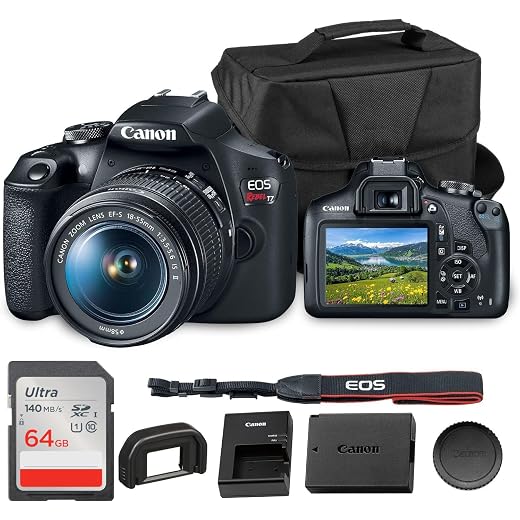


Buy the Rebel T7 if you are a student, first-time camera owner, parent, casual traveler, or hobbyist seeking the best cheap DSLR for beginners. It is especially sensible as a used purchase below $500, provided the body is clean and the kit zoom is included.
Skip it if you need 4K, a flip screen, Bluetooth, fast bursts, advanced action tracking, weather sealing, or excellent video autofocus. Skip it if a used SL3, T8i, Nikon D3500, or entry mirrorless body costs only a little more. The T7 is compelling when it is inexpensive, not when it is merely familiar.
FAQs: is the Canon EOS Rebel T7 right for you?
Is the Canon EOS Rebel T7 still worth buying?
Yes, as an inexpensive first DSLR for still photography, family images, travel, and learning exposure. It is less convincing for video, fast action, and buyers who can afford a newer used body.
What is the difference between the Canon Rebel T7 and 2000D?
They are regional names for essentially the same camera. Rebel T7 is the name used in North America, while EOS 2000D is used in several other markets.
Is the Canon Rebel T7 good for portraits?
Yes. The 24.1MP sensor and Canon color make it a good portrait camera, particularly when used with a bright 50mm f/1.8 prime option and selected-point autofocus.
Is the Rebel T7 decent for landscapes and travel?
Yes, especially in daylight. It is lightweight, makes detailed 24MP images, and works well with the 18–55mm kit zoom, but it lacks weather sealing and a tilting screen.
Does the Canon Rebel T7 have 4K video or a flip screen?
No. It records Full HD 1080p up to 30 fps and has a fixed, non-touch rear screen.
Does the Canon Rebel T7 have Wi-Fi and Bluetooth?
It has built-in Wi-Fi and NFC, but no Bluetooth. Wi-Fi is useful for basic phone transfer and remote shooting.
How good are autofocus and low-light performance?
The center cross-type AF point works well for deliberate subjects, but the nine-point system is limited for fast action. ISO 1600–3200 is practical for many indoor scenes; ISO 6400 is best reserved for smaller output.
What is real-world battery life like?
Around 500 shots per charge is a useful expectation under normal finder-based shooting. Take a spare LP-E10 for travel, events, frequent screen use, or Wi-Fi transfer.
What EF and EF-S options work best with the Rebel T7?
The 18–55mm kit zoom is a sensible start. A small 50mm f/1.8 prime choice helps with portraits and indoor family pictures, while a 55–250mm stabilized telephoto pick is useful for travel, school sport, and distant subjects.
Final verdict
The Canon EOS Rebel T7 is not trying to impress a specification-driven buyer. It is a simple 24.1MP DSLR that gives beginners a practical way to learn framing, exposure, and focus while making photographs that can look genuinely excellent.
Buy it at the right price, use it for family photos, portraits, travel, landscapes, and everyday learning, and it will serve you well. Spend more if quick action, flip-screen framing, 4K, or video-centered work is part of the plan. The T7 earns its place as a first DSLR because it keeps the barrier to serious photography low.


