
Best Compact Cameras 2026: Top Picks for Travel, Street, Vlogging & Everyday Photos

What are the best compact cameras right now? The Fujifilm X100VI is the best compact camera overall for photographers who enjoy street photography, travel, and the discipline of working with one excellent fixed focal length. The Ricoh GR IV is the better choice when genuine pocketability matters most, while the Leica Q3 family serves enthusiasts who want full-frame image quality in a fixed-lens body they can carry far more easily than a larger kit.
For creators who shoot as much video as stills, the Canon PowerShot V1 and Sony ZV-1 II are more practical choices. Both are built around vlogging, YouTube, vertical social clips, flip screens, responsive autofocus, and quick sharing. They are not replacements for a full production setup, but they are much easier to carry than a typical best mirrorless camera setup with several lenses, batteries, and accessories.
A compact camera is not just one category with one winner. Some models fit in a jacket pocket, some belong in a small shoulder bag, and others are premium fixed-lens cameras that can replace an interchangeable-lens kit for a photographer who prefers a simpler way of shooting. The right choice depends on whether you care most about image quality, zoom range, low-light ability, video, durability, or having a camera you will actually bring along.
Best compact camera in 2026






Travelers and families often need a different kind of compact. Panasonic’s ZS99 is a strong fit for holidays and sightseeing because its long zoom handles wide landscapes, distant architecture, and family moments from one small body. The OM System Tough TG-7 is the better choice for snorkeling, rainy hikes, snow trips, and rough outdoor use, while low-cost Kodak PIXPRO and Canon IXUS/ELPH-style options remain sensible for people who simply want an easy best point-and-shoot camera alternative to a phone.
Compact cameras also fill the gap between larger systems. The mirrorless camera offers more lens options, and the best DSLR camera can still make sense for long events, wildlife, or studio work, but both demand more space and commitment. A good compact lets you work quickly, stay unobtrusive, and keep photography enjoyable on normal days, not only when you pack a dedicated camera bag.
Best compact camera overall for travel and street
The Fujifilm X100VI is the best compact camera for travel and street photography if you enjoy choosing a frame, working with one familiar field of view, and coming home with excellent JPEGs as well as flexible RAW files. It is not pocket-sized, and the fixed 35mm-equivalent view will not suit every subject, but it makes photography feel deliberate without complicating travel.
1. Fujifilm X100 VI: Best overall for travel and street
FUJIFILM X100 VI Black
The X100VI earns its place at the top because it gets the difficult balance right: high-end image quality, a small enough body to carry every day, and controls that encourage you to pay attention rather than shoot endlessly. Its 40.2MP APS-C sensor has plenty of detail for large prints, crops, portfolio work, and travel landscapes. The fixed 23mm f/2 lens delivers a classic 35mm equivalent perspective wide enough for a street scene, restaurant table, or environmental portrait, but not so wide that people look stretched at the edges.
The camera’s five-axis in-body stabilization is a meaningful upgrade for available-light shooting. It lets you handhold slower shutter speeds in museums, at blue hour, or while wandering through a city after dinner. The hybrid viewfinder is another genuine strength. Use the optical finder when you want to see beyond the frame and anticipate a moment; switch to the electronic viewfinder when you need exposure and film simulation preview. That is a better shooting experience than staring at a rear screen all day.
Fujifilm’s film simulations are a big part of the appeal, but they are not a gimmick. If you prefer finishing a trip with carefully chosen JPEGs instead of a mountain of RAW editing, the X100VI offers convincing color profiles for subtle, vivid, or monochrome work. It also records 6.2K video and 4K at higher frame rates, though the X100VI is a stills-first compact, not the best compact camera for vlogging.
Buy it if you want one premium fixed-lens compact for travel photography, street shooting, family life, and personal projects. Skip it if you need telephoto reach, a true pocket compact camera, or a flip-forward screen for daily video.
Pros
- 40.2MP APS-C sensor produces detailed stills and large-print files
- Fixed 23mm f/2 lens suits street, travel, portraits, and everyday scenes
- Five-axis IBIS helps in low light and at slower shutter speeds
- A hybrid optical/electronic viewfinder is enjoyable and practical
- Excellent film simulations and JPEG workflow
- Strong 6.2K and 4K video for occasional hybrid use
Cons
- Premium price and frequent stock shortages
- Not pocketable in the way a Ricoh GR is
- Fixed focal length is limiting for wildlife and distant subjects
- Screen tilts but does not face forward for self-recording
2. Ricoh GR IV / GR IV HDF: Best pocket compact for street photography
RICOH GR IV Premium Digital Compact Camera
The Ricoh GR IV is the best compact camera for street photography when the priority is carrying a serious APS-C camera everywhere without feeling like you brought a camera bag. It slips into a coat pocket, starts quickly, and offers a 28mm-equivalent view that feels natural for city scenes, travel, architecture, and candid documentary-style photography.
The point of the GR IV is speed without spectacle. It does not draw attention, which is invaluable when you want honest moments rather than posed reactions. Snap Focus lets you pre-set a focus distance and shoot immediately, an old-school method that becomes addictive once you understand it. Walking through a market or photographing fast street scenes, you can set the aperture and distance, lift the camera, and catch the frame before a conventional autofocus system has finished deciding where to look.
Its APS-C sensor delivers image quality far beyond typical pocket cameras, and the updated stabilization helps when light drops. The HDF version adds a highlight-diffusion filter intended for gentler glow around bright points, useful for nighttime city lights, portraits, or photographers who want a less clinical feel without editing every image afterward. The standard version remains the safer choice if you want maximum crispness and do not want the effect permanently built in.
The GR IV is not a general-purpose family compact camera. There is no zoom, no viewfinder, limited video ambition, and the 28mm focal length demands that you get close. But for photographers who have missed pictures because a larger camera stayed home, the GR IV is the best everyday carry compact on the list.
Pros
- APS-C image quality in a genuinely pocketable body
- Fast Snap Focus suits candid street and documentary work
- 28 mm-equivalent view works well for travel and everyday scenes
- In-body stabilization aids low-light handheld shooting
- Discreet design is ideal for candid photography
Cons
- No built-in viewfinder
- A fixed wide lens is not ideal for portraits from a distance
- Video features are modest
- Controls and menu logic take time to learn
Best compact camera for enthusiasts who want fixed-lens quality
The Leica Q3 family is the premium choice for enthusiasts who want a full-frame compact and do not mind paying for it. Choose the Q3 for a wider 28 mm equivalent perspective; choose the Q3 43 if you prefer a normal field of view for portraits, details, and everyday storytelling.
3. Leica Q3 and Q3 43: Best premium full-frame compact
Leica Q3 Compact Digital Camera (19080) (Black)
The Leica Q3 family is for photographers who want a full-frame sensor, a bright fixed lens, and a compact camera that makes them slow down in the best way. Both versions use a 60MP full-frame sensor, a crisp electronic viewfinder, weather-resistant construction, and excellent manual controls. The decision is really about focal length: the Q3’s 28mm f/1.7 is more flexible for travel, architecture, and street scenes, while the Q3 43’s 43mm f/2 feels closer to how many people naturally see and is better for portraits and quieter compositions.
That 60MP resolution does more than inflate a specification sheet. It allows sensible digital crop modes while retaining enough detail for serious output. With the Q3, a 35mm or 50mm crop can still be useful for web work and moderate prints. With the Q3 43, you can work closer to a classic normal or short-telephoto look without carrying another lens. Neither replaces a real zoom when you need rapid framing changes, but both provide more flexibility than most fixed-lens compacts.
Autofocus is dependable for everyday use, although a Sony RX100 VII is a safer choice for quick children or unpredictable action. Video is capable, including high-resolution options, but a Leica Q3 is a compact camera you buy for photography first. The files have plenty of range, the controls encourage intentional exposure choices, and the EVF makes composing in harsh light straightforward.
This is a luxury purchase, not a rational value leader. Yet for enthusiasts who want a compact main camera for personal work, travel, and gallery-quality prints, the Q3 family is difficult to replace.
Pros
- 60MP full-frame sensor provides exceptional detail and crop latitude
- Choice of 28mm f/1.7 or 43mm f/2 fixed focal length
- Excellent EVF, touchscreen, and premium physical controls
- Strong low-light performance and rich RAW files
- Weather-resistant body supports serious travel use
Cons
- Very expensive
- Neither body is truly pocketable
- Fixed focal length requires commitment
- Video features are capable but not creator-first
4. Ricoh GR III / GR IIIx: Best older APS-C street compact
RICOH GR IIIx Premium Digital Compact Camera, 40mm Focal Length
The Ricoh GR III and GR IIIx remain excellent compact cameras for photographers who want APS-C quality at a lower cost than a GR IV and are comfortable buying a proven older design. Choose the GR III for the 28mm-equivalent field of view; choose the GR IIIx for its 40mm-equivalent perspective, which is easier for portraits, details, and less crowded compositions.
The GR III is still one of the most pocketable serious cameras available today. It uses the same basic philosophy as the newer GR IV: no viewfinder, no zoom, no bulky grip, and no unnecessary visual drama. It is a compact for people who know what focal length they like and want a camera always within reach. Image quality remains excellent, particularly in RAW, and the built-in stabilization helps offset the modest f/2.8 aperture in dim places.
The IIIx is often an overlooked gem. Its 40mm-equivalent lens feels less wide and more intimate than the standard GR III, so it works beautifully for travel portraits, food, objects, and people in their surroundings. Neither model is a video machine; 1080p is the practical ceiling, and buyers interested in 4K should look elsewhere. But as a stills-focused backup or main street camera, the GR III family remains compelling.
Pros
- APS-C sensor in a very small body
- Choice of 28mm or 40mm-equivalent perspectives
- Excellent RAW image quality for the size
- Sensor-shift stabilization improves low-light flexibility
- Often a better value than the newest premium compacts
Cons
- No 4K video
- No built-in viewfinder
- Fixed screen and limited battery life
- Autofocus is less confident than current creator cameras
Best compact camera for vlogging and YouTube
The Canon PowerShot V1 is the best compact camera for vlogging and YouTube, offering a compact body built around video rather than stills nostalgia. The Sony ZV-1 II is smaller and simpler for social content, while the Canon G7 X Mark III remains a familiar option for creators who want a brighter short zoom and a pocket-friendly hybrid.
5. Canon PowerShot V1: Best video-first compact
The Canon PowerShot V1 is the compact camera I would choose for a creator who records more video than still photographs but does not want the size or complexity of an interchangeable-lens setup. Its large 1.4-type sensor, ultra-wide 16–50mm-equivalent zoom, vari-angle screen, and internal cooling make it more serious than the average pocket vlogging camera. It gives you space for handheld self-recording at the wide end, then enough reach for detail shots, food, or a tighter shot of the camera.
The wide starting focal length is crucial. Many compact zooms begin too tight for arm’s-length vlogging, particularly indoors. The V1 avoids that issue, and the flip screen makes solo work simple. Canon Log 3 and 10-bit capture are welcome for creators who want to grade footage or match it with larger Canon compact cameras, while the camera’s stabilization helps tame walking shots. It still cannot duplicate the smooth motion of a gimbal, but it is far easier to live with than a rig.
For still photography, the V1 is better than many video-first compacts, but it is not the camera I would buy solely for street or landscape work. The zoom range favors creators, not telephoto travelers, and there is no EVF for photographers who prefer composing away from a screen. Its body is also bigger than a ZV-1 II or RX100 VII.
For YouTube studios, travel vlogs, online courses, product demonstrations, and talking-head footage, though, the V1’s creator-focused difficulty is very hard to argue with.
Pros
- Large 1.4-type sensor improves video and low-light quality
- A 16–50 mm equivalent zoom is useful for handheld self-recording
- Vari-angle screen makes solo vlogging easy
- Internal cooling supports longer recordings
- Canon Log 3 and 10-bit capture provide grading flexibility
- Good stabilization for handheld creator work
Cons
- No electronic viewfinder
- Larger than the smallest pocket compacts
- Limited telephoto reach for travel wildlife
- Premium price for a fixed-lens creator camera
6. Sony ZV-1 II: Best compact for social video
Sony ZV-1 II Premium Compact Digital Camera 4K Video – Black
The Sony ZV-1 II is the best compact camera for creators who want a simple, lightweight tool for YouTube Shorts, TikTok, Instagram, and straightforward travel vlogs. It uses a 1-inch sensor and a wide 18–50mm-equivalent zoom, which is much more useful for self-recording than the longer but tighter zoom found on many travel compacts.
Sony gets the basics right for solo content. The side-opening touchscreen can face forward, Eye AF stays on a presenter reliably, and Product Showcase mode shifts focus from your face to an item held near the camera without the usual hand-waving ritual. The built-in directional microphone and included windscreen are practical for quick outdoor clips, though a dedicated microphone remains the better solution when sound matters.
The ZV-1 II is not a photography purist’s dream. There is no viewfinder, controls are minimal, and the zoom range is short. But that is precisely why it stays small and approachable. You can throw it in a handbag or jacket pocket, pull it out for a quick explanation, and transfer clips to a phone without turning the process into a production.
Pros
- Wide 18–50mm-equivalent zoom suits arm’s-length vlogging
- Excellent Eye AF and Product Showcase mode
- Flip-out screen supports self-recording
- Compact, lightweight body for daily carry
- Good built-in microphone setup for casual clips
Cons
- No viewfinder
- Short zoom range for travel photography
- Small battery requires spares for long days
- Stabilization is less polished than a gimbal for walking footage
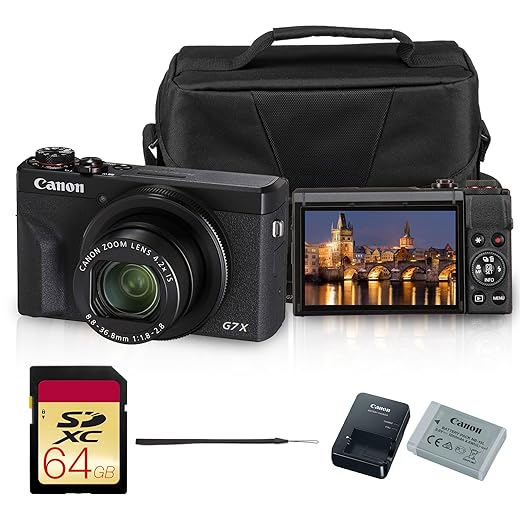
7. Canon G7 X Mark III: Best compact hybrid for casual creators
The Canon G7 X Mark III is still a useful compact hybrid for photographers who also make casual videos, especially when found at a sensible price. Its 20.1 MP 1-inch sensor and bright 24–100 mm equivalent f/1.8–2.8 zoom make it more versatile for stills than a video-first V1 or ZV-1 II, while the flip-up screen supports self-recording.
The bright lens is the real attraction. At the wide end, f/1.8 helps with indoor family photos, restaurant scenes, and evening travel shots. The 100mm-equivalent end gives more portrait flexibility than the V1 or ZV-1 II. It records 4K and supports live-streaming-oriented features, but its autofocus and video workflow are now less assured than the latest creator models.
Get the G7 X Mark III if you want one compact for photos, travel, family events, and occasional vlogs. If video is the primary job, choose the V1. If stills are primary and a pocket zoom matters, the Sony RX100 VII is the stronger alternative.
Pros
- Bright 24–100 mm equivalent f/1.8–2.8 zoom
- 1-inch sensor performs well for a small compact
- Flip-up screen helps with self-recording
- Good balance of stills and casual 4K video
- Pocketable enough for travel and family use
Cons
- Older autofocus and video system
- Flip-up screens can conflict with some microphone setups
- No viewfinder
- Limited battery life during 4K recording
Best compact camera for travel, zoom, and everyday use
The Sony RX100 VII is the best pocket travel zoom for photographers who want a 24–200mm-equivalent range and fast autofocus in a minimal package. Panasonic ZS99 is the better choice when reach matters more than sensor size, especially for family travel and daytime sightseeing.
Sony RX100 VII Premium Compact Camera 1.0-Type CMOS Sensor Black
8. Sony RX100 VII: Best pocket travel zoom
The RX100 VII is the compact camera for travelers who refuse to choose between portability and reach. Its 24–200mm-equivalent zoom covers city views, portraits, museum details, food, distant buildings, and occasional wildlife without asking you to pack another lens. The 1-inch sensor cannot match APS-C or full-frame compacts in low light, but it is far ahead of phone-sized small-sensor travel compact cameras when you want a printable file or meaningful background separation.
Sony’s autofocus is the reason to pay attention. Real-time tracking and Eye AF make the RX100 VII unusually capable for children, pets, quick candid moments, and people moving through a scene. A pop-up EVF may sound old-fashioned, yet it is extremely useful in bright sun when rear screens become hard to see. The camera also shoots 4K video and includes a microphone input, which gives it more creator potential than most pocket zooms.
Its main compromise is ergonomics. The body is tiny, controls are cramped, and the 24–200mm lens gets dimmer as you zoom in. You will want a spare battery for a full travel day. But there is something liberating about having real telephoto reach in a camera that can disappear into a pocket.
Pros
- 24–200 mm equivalent zoom in a pocketable body
- Fast Eye AF and subject tracking
- 1-inch sensor gives strong results for a travel zoom
- Pop-up EVF is useful in bright daylight
- 4K video and microphone input add hybrid versatility
Cons
- Small grip and cramped controls
- Lens is slower at telephoto settings
- Battery life is modest
- Expensive compared with many 1-inch compacts
9. Panasonic Lumix ZS99 / TZ99: Best long-zoom travel compact
Panasonic LUMIX TZ/ZS99 Point and Shoot Camera, Compact Camera for Travel with 30x Zoom with 24-720mm Zoom Lens, and 4K Video/Photo, Great for Travel and…
The Panasonic ZS99, also sold as the TZ99 in some markets, is the best compact camera for family travel when you want a long zoom in one small body. It is not the strongest low-light camera in this guide, but its wide-to-telephoto range lets you capture a city panorama in the morning, a child on a distant stage in the afternoon, and a detail across a plaza without changing cameras.
This kind of compact zoom is about convenience. The sensor is small, so it works best in daylight or with steady hands, but Panasonic’s stabilization is valuable at longer focal lengths. The touchscreen and familiar controls make it friendly for beginners, while 4K video gives travelers an easy way to make short clips without carrying a dedicated video camera.
Choose it for holidays, cruise trips, family vacations, and sightseeing. Avoid it if you mostly shoot indoor events, night streets, or portraits with blurred backgrounds; a 1-inch compact camera or an APS-C fixed-lens compact is better for those jobs.
Pros
- Long zoom range in a travel-friendly body
- Useful stabilization for telephoto shots
- 4K video for vacation clips
- Simple touchscreen operation
- Good choice for family trips and daytime sightseeing
Cons
- Small sensor struggles in low light
- Less background blur than larger-sensor cameras
- Image quality falls behind 1-inch and APS-C compacts
- Not built for serious action or professional work
Best compact camera for adventure and waterproof use
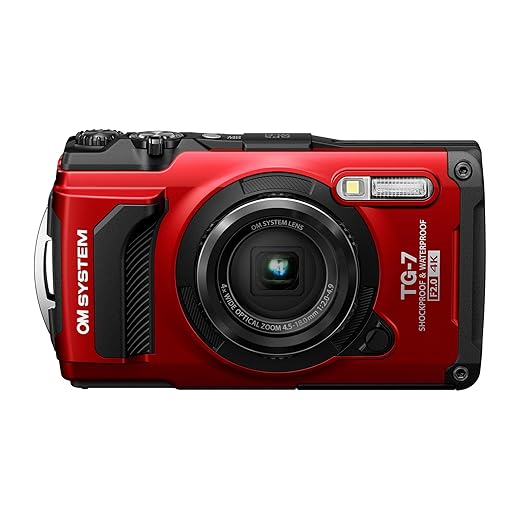
The OM System Tough TG-7 is the best compact camera for waterproof and rugged use because it is made for situations where a premium fixed-lens compact would be risky: snorkeling, wet hikes, ski trips, dusty trails, and rough family adventures. Its image quality is modest compared with larger sensors, but the freedom to use it without worrying is the whole point.
OM System OLYMPUS Tough TG-7 Red Underwater Camera, Waterproof, Freeze Proof, High Resolution Bright, 4K Video 44x Macro Shooting (Successor Olympus TG-6)
10. OM System / Olympus Tough TG-7: Best rugged waterproof compact
The TG-7 is one of the few compact cameras on this list you can take into water, mud, freezing weather, and close-up outdoor work without treating it like a fragile object. It is waterproof, crush-resistant, freezeproof, and built for people who actually travel hard rather than simply photograph hotel balconies. If you need a compact for snorkeling, kayaking, hiking, skiing, camping, or kids near a pool, it is the obvious answer.
The microscope-style close-up modes are a bigger deal than they sound. Flowers, insects, shells, food, textures, and tiny objects become entertaining subjects because the TG-7 can focus extremely close. It also offers 4K video and useful location-oriented features, making it a good adventure diary camera.
The small sensor means it is not a night photography champion. In dim light, it needs careful technique, and it will not rival the X100VI, GR IV, or RX100 VII for fine detail or high-ISO cleanliness. The zoom is modest, too. But no other compact here combines this level of physical protection with a genuinely useful close-up capability.
Pros
- Waterproof and rugged for real outdoor use
- Excellent close-focus and macro-style shooting modes
- 4K video in a compact adventure body
- Easy to use with gloves or wet hands
- Great for snorkeling, hiking, skiing, and family trips
Cons
- Small sensor limits low-light image quality
- Modest zoom range
- Fewer manual controls than enthusiast models
- Not intended for large prints or serious portrait work
Best budget compact camera for casual users
For casual users, Kodak PIXPRO FZ45/FZ55 models offer inexpensive, simple point-and-shoot photography, while Canon IXUS 285 HS/ELPH 180-class cameras are better for people who want a slim pocket camera with familiar auto modes. Neither competes with premium compacts in low light or video, but both are easier to hand to a child, parent, or occasional traveler than a complicated enthusiast compact camera.
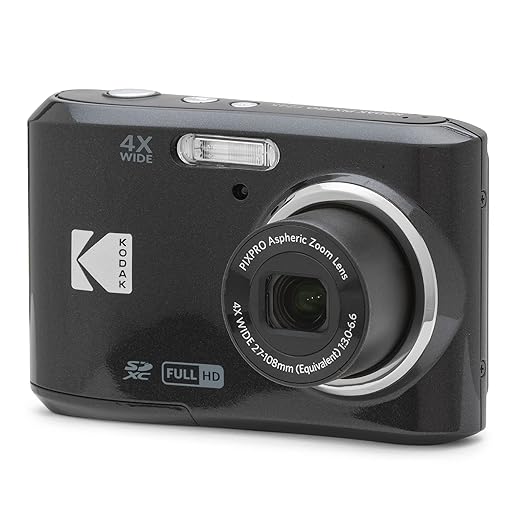
11. Kodak PIXPRO FZ45 / FZ55 / C1-class: Best cheap travel compact
A Kodak PIXPRO FZ45 or FZ55 is the right compact camera when the goal is simple: take better, more intentional vacation photos than a phone sometimes provides without spending much money or learning a technical system. These compact cameras offer modest optical zoom ranges, basic image controls, and straightforward automatic modes in a light body that can stay in a bag every day.
They are best used in daylight beach trips, parks, family gatherings outdoors, school events, and holiday snapshots. The small sensor and basic autofocus are not built for night scenes, fast sports, or large wall prints. Video is limited to standard high-definition recording, so creators should not buy one for YouTube or advanced social work.
That sounds restrictive, but it is also the reason the cameras stay affordable. A simple dedicated point-and-shoot can still be useful for a beginner, a child, a backup travel camera, or a family member who finds a phone frustrating. Keep expectations realistic and use it in the best light, and it can make photography more fun than constantly fighting a touchscreen.
Pros
- Very affordable and simple to operate
- Light body with useful everyday zoom
- Automatic modes suit beginners and casual users
- Good option for daylight travel and family snapshots
- Low-risk choice for children or backup use
Cons
- The small sensor is weak in low light
- Basic autofocus and slow response for moving subjects
- HD rather than advanced 4K video
- Limited RAW and manual-control options
12. Canon IXUS 285 HS / ELPH 180-class: Best slim casual compact
Canon PowerShot ELPH 180 Digital Camera w/Image Stabilization and Smart AUTO Mode (Silver), 0.90in. x 3.70in. x 2.10in. – 1093C001
Canon’s IXUS 285 HS and ELPH 180-class compacts are for people who want the old-school point-and-shoot experience: slim body, optical zoom, straight-forwards auto settings, and no desire to study camera menus. The IXUS 285 HS is the more capable route, with a 20MP sensor, 25–300mm-equivalent zoom, Wi-Fi, and Full HD video, while the ELPH 180-class approach is even simpler and cheaper.
These are cameras for birthdays, family albums, day trips, school events, and carrying in a pocket when you would rather not use your phone. They start quickly, have straightforward controls, and avoid the bulk of an enthusiast compact. The long-ish zoom on the IXUS is genuinely useful for details and distant subjects at a daytime event.
The limitations are predictable: low-light performance is basic, there is little room for editing compared with RAW-capable models, and video is not a reason to buy either. Still, if the person using the camera values simplicity over image perfection, these remain sensible compact options.
Pros
- Slim, lightweight, pocket-friendly design
- Easy automatic modes for casual users
- IXUS 285 HS offers a useful 25–300 mm equivalent zoom
- Wi-Fi sharing on the more advanced option
- Good for albums, parties, and family trips
Cons
- Small sensor struggles indoors and at night
- No advanced video features
- Limited manual control and editing latitude
- Not suitable for serious action photography
Fujifilm X100VI vs. Ricoh GR IV: which street compact should you buy?
Choose the Fujifilm X100VI if you want a viewfinder, a 35mm-equivalent perspective, excellent film simulations, and a camera that can become the center of your photography habit. Choose the Ricoh GR IV if you need an APS-C street camera that actually fits in a pocket and lets you work quickly without attracting attention.
The Fujifilm is the more complete and emotionally satisfying camera. It offers better video, a hybrid finder, brighter f/2 optics, and more deliberate controls. The Ricoh is the more practical everyday carry compact camera. It is smaller and lighter, and its 28 mm equivalent focal length plus Snap Focus makes it superb for spontaneous street work. Neither is objectively better; they reward different habits.
Leica Q3 vs Sony RX100 VII: premium full-frame vs pocket zoom
The Leica Q3 is for enthusiasts who want the best image quality, full-frame character, and a fixed-lens photographic experience. The Sony RX100 VII is for travelers who need a genuinely compact camera with 24–200mm-equivalent reach and dependable autofocus for family moments.
The Leica wins decisively for resolution, low light, large prints, and tactile shooting. Sony wins for portability, zoom flexibility, and speed. If you are deciding between them, do not compare them as substitutes: one replaces a premium fixed-lens camera; the other replaces a travel zoom kit.
Canon PowerShot V1 vs. Sony ZV-1 II: which is better for creators?
Choose the Canon PowerShot V1 for more serious 4K work, a larger sensor, internal cooling, 10-bit recording, and a 16–50mm-equivalent zoom that supports both self-recording and B-roll. Choose the Sony ZV-1 II if you want a lighter, smaller camera for quick social posts, casual YouTube videos, and easy autofocus.
The V1 is the better compact for a creator who expects to color-grade, record longer takes, or make YouTube videos regularly. The ZV-1 II is the more convenient camera to keep in a small bag and use without planning. Both beat traditional travel compact cameras for direct-to-camera work.
Best compact camera deals: what to expect
The best deals usually appear on previous-generation models rather than the newest premium releases. Canon G7 X Mark III, Ricoh GR III/IIIx, Sony RX100 VII, Panasonic ZS99, and rugged TG-7 bundles are more likely to receive useful discounts than cameras with persistent demand, such as Fujifilm X100VI or Leica Q3 bodies.
For a budget below $500, look first at the Panasonic ZS99 during sales, Kodak PIXPRO models, or an older Canon compact. Between $500 and $1,000, a discounted Canon G7 X Mark III, Sony ZV-1 II, Ricoh GR III, or Sony RX100 VII can be a much smarter buy than a cheap new camera with a small sensor. Above that price range, you should choose based on focal length and shooting style rather than temporary discounts; an X100VI, GR IV, or Leica Q3 is only a sensible option if you truly want its specific features.
FAQs: which compact camera should I buy?
Which compact camera is best overall?
The Fujifilm X100VI is the best compact camera overall for travel and street photographers who value APS-C image quality, a 35mm-equivalent fixed lens, stabilization, and excellent JPEG color. The Ricoh GR IV is the better choice if true pocketability is non-negotiable.
Which compact camera is best for travel and street photography?
The Fujifilm X100VI is best for an immersive, stills-first travel and street experience. The Sony RX100 VII is better for travelers who need a 24–200mm-equivalent zoom, while the Panasonic ZS99 suits daylight family travel where maximum reach is the priority.
Which compact camera is best for vlogging and YouTube?
The Canon PowerShot V1 is the strongest compact for serious vlogging because it combines a wide creator-friendly zoom, a large sensor, a flip screen, cooling, and 10-bit video. The Sony ZV-1 II is the smaller and easier option for casual social content.
Which compact camera is best for families and budget travel?
The Panasonic ZS99 is the best all-round family travel compact because its long zoom covers wide scenery through distant details. Kodak PIXPRO and Canon IXUS/ELPH models are better for buyers who want the lowest cost and simplest controls.
Which compact camera is best for adventure and waterproof use?
OM System Tough TG-7 is the clear pick for water, snow, mud, hiking, snorkeling, and close-up outdoor photography. It gives up large-sensor image quality in exchange for a body you can use without constant worry.
Is the Fujifilm X100VI worth it over the Ricoh GR IV?
It is worth paying more if you value the hybrid viewfinder, 35mm-equivalent f/2 lens, film simulations, and more advanced hybrid video. Choose the GR IV instead if a real pocket-sized APS-C camera and quick Snap Focus shooting fit your life better.
Is the Leica Q3 worth it for enthusiasts?
The Leica Q3 is worth it for photographers who want a premium full-frame fixed-lens camera for personal work, travel, portraits, and large prints and who are comfortable with the price. It is not the practical choice for zoom flexibility, casual family use, or budget-conscious buyers.
Which compact camera is best under $500?
A Panasonic ZS99 during a sale is the most versatile new travel option near that price, while Kodak PIXPRO FZ45/FZ55 models are the simple low-cost choice. A used Ricoh GR III, Sony ZV-1 II, or Canon G7 X Mark III can offer much better image quality if you find one in budget.
What is the best compact camera for everyday carry?
The Ricoh GR IV is the best everyday carry choice because it combines an APS-C sensor with a body small enough to bring everywhere. The Sony RX100 VII is the better everyday compact if you need a zoom.


