
Best Action Camera for Vlogging 2026: Top 12 Ranked for YouTube, Travel, Low Light, Audio, Stabilization, 360, Compact & Hands-Free Vlogs

What is the best action camera for vlogging? For most people, the Insta360 Ace Pro 2 is the easiest recommendation because its flip screen, larger sensor, strong low-light results, and simple editing tools solve the problems vloggers run into every day. The GoPro HERO13 Black is the better choice when your vlog involves intense riding, skiing, surfing, helmet mounts, or chest-mounted POV footage, while the DJI Osmo Action 6 is the strongest alternative for creators who want a larger sensor, dependable audio options, and a straightforward travel setup.
A good vlogging camera does more than survive rain or record a wide-angle clip. It needs usable stabilization when you are walking, a screen that helps you stay in frame, decent sound in wind, a battery that lasts through a day out, and an editing workflow that does not turn a ten-minute vlog into a two-hour chore. The cameras below cover that range, from full-featured action cameras to 360 models, pocket gimbals, and tiny hands-free cameras.
Best Action Camera for Vlogging Overall





The Insta360 Ace Pro 2 is the best action camera for vlogging overall because it combines a flip screen, a large 1/1.3-inch sensor, 4K high-frame-rate recording, practical stabilization, and creator-focused software. It is easier to use for a solo creator than a traditional GoPro-style body because you can see yourself while filming without adding a separate monitor.
Insta360 Ace Pro 2: Best for Flip-Screen Vlogging
Insta360 Ace Pro 2 Xplorer Bundle
The Ace Pro 2 makes the most sense for vloggers who shoot themselves as often as they shoot the world around them. A flip screen sounds like a small detail until you film a walking intro, a food stop, or a quick hotel room update and realize you cannot tell whether your face is centered. With the screen facing forward, you can check framing, exposure, and whether the horizon has wandered off level before you record a full take.
Its 1/1.3-inch sensor gives it a useful advantage over smaller-sensor action cameras in evening streets, indoor cafés, and cloudy travel days. You still should not expect mirrorless-camera depth of field or clean footage in near-darkness, but the Ace Pro 2 gives you more usable detail and less harsh noise than many rugged compact cameras. PureVideo mode is helpful for night walks, city scenes, and dim restaurants, although stabilization can be less aggressive in the darkest settings.
The camera is also a good fit for TikTok, Instagram Reels, and YouTube Shorts because it makes vertical framing easier. You can record normal clips, create quick edits in the Insta360 app, and use AI-assisted tools to pull together a usable highlight sequence without sitting at a laptop. For longer YouTube work, the ability to record high-quality 4K footage, connect an external microphone, and quickly transfer clips gives it a more serious side than its friendly interface suggests.
It is not perfect. The body is not as deeply integrated into a long-established mount universe as GoPro, and the ultra-wide perspective still needs careful placement for talking-to-camera work. But if you are buying one action camera for travel vlogging, daily videos, solo creator work, and occasional adventure shooting, the Hero 11 is the one I would start with.
Pros
- Flip touchscreen makes solo framing simple
- Large 1/1.3-inch sensor helps in low-light vlogs
- Strong 4K slow motion for travel and action clips
- Useful app-based editing and highlight tools
- External microphone support for better spoken audio
- Waterproof, compact body for travel and outdoor work
Cons
- Mount ecosystem is smaller than GoPro’s
- Wide field of view can distort close-up faces
- PureVideo settings may limit some recording options
- Premium price compared with older action cameras
Best Action Camera for Travel Vlogging
For travel vlogging, the best option depends on how you travel. The DJI Osmo Pocket 3 is better for walk-and-talk footage, city scenes, food videos, and quiet interior clips because its built-in gimbal produces smooth, natural movement. The Insta360 Ace Pro 2 is better if your trips include water, hiking, biking, or situations where a waterproof action camera is safer.
DJI Osmo Pocket 3 Vlogging Camera DJI Osmo Pocket 3 Vlog Bundle
DJI Osmo Pocket 3: Best Compact Vlogging Camera
The DJI Osmo Pocket 3 is not a traditional action camera, but it may be the best vlogging camera here for creators who primarily record themselves walking, talking, traveling, and exploring cities. Its three-axis mechanical gimbal creates a calmer, more intentional look than electronic stabilization alone. Footage does not have the slightly cropped, ultra-wide action-cam feel that can make casual lifestyle vlogs look too aggressive.
The rotating touchscreen is a major benefit for solo shooting. Turn it vertical for TikTok or Reels, turn it horizontal for YouTube, and the camera follows the orientation without forcing you to rebuild your setup. Face tracking is also genuinely useful: set the Pocket 3 on a small tripod, step into frame, and it can keep you centered while you cook, explain a product, or speak to a camera in a hotel room.
Its larger sensor is excellent for indoor vlogging, restaurants, night markets, and evening streets. This is the camera I would take for a food vlog, a city guide, or an interview where smooth movement and natural-looking faces matter more than being waterproof. Pairing it with DJI Mic 2 makes the setup even stronger for spoken content, especially outdoors where a camera’s built-in microphones cannot fully defeat wind.
The trade-off is fragility. A gimbal camera has moving parts, so it is not the tool I would strap to a mountain bike, take into a wave, or throw into a bag unprotected. Think of it as a compact creator camera first and an adventure tool second.
Pros
- Three-axis gimbal creates smooth handheld footage
- Large sensor performs well indoors and at night
- Rotating screen supports vertical and horizontal video
- Face tracking helps solo creators stay framed
- Strong integration with DJI Mic 2
- Compact enough for everyday travel carry
Cons
- Not waterproof without additional protection
- Gimbal is more delicate than an action-camera body
- Not ideal for helmet, chest, or bike mounting
- Requires care around sand, rain, and impacts
GoPro HERO13 Black: Best for Adventure Travel Vlogs
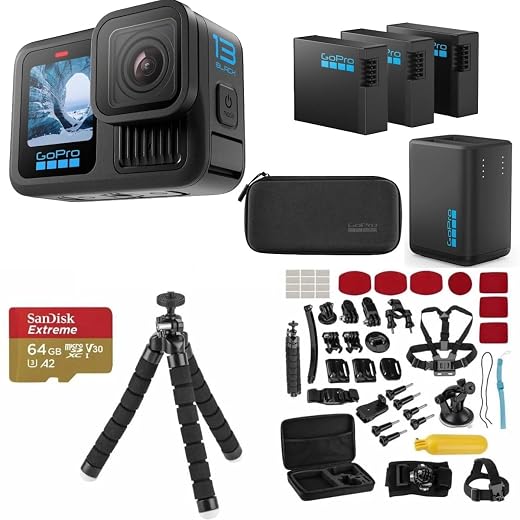
GoPro HERO13 Black Action Camera with 3 Enduro Batteries, Dual Charger, 64GB SD, 5.3K HDR Video, 27MP Photos, HyperSmooth Stabilization, Waterproof Design,…
The GoPro HERO13 Black is the best action camera for travel vloggers whose trips are built around movement: mountain biking, motorcycle touring, skiing, hiking, surfing, climbing, or anything that makes a gimbal feel risky. It records detailed 5.3K 60fps video, handles slow motion well, and uses HyperSmooth stabilization to keep walking and action footage usable even when the ground is doing its best to ruin the shot.
GoPro camera’s main strength is not just video quality; it is reliability in awkward situations. You can move from a rainy trail to a kayak to a chest mount without babying the camera. The waterproof body, Enduro battery options, and huge mounting ecosystem make it easy to build a travel kit around the type of trip you actually take rather than the kind of content you hope to make one day.
For direct-to-camera vlogging, the HERO13 has limitations. Its front display is useful for status information but not a true front-facing framing screen, and serious audio often means adding the Media Mod or using a wireless solution. That adds bulk, which matters if you are trying to keep your bag light. Still, if the vlog is about doing something rather than standing and talking, the HERO13 makes more sense than the Pocket 3.
Pros
- Detailed 5.3K 60fps video for cropping and editing
- HyperSmooth stabilization handles active travel well
- Deep and mature mounting ecosystem
- Rugged waterproof body for rain, water, and dust
- Enduro batteries help during cold-weather trips
- Strong slow-motion modes for action B-roll
Cons
- No true flip screen for self-framing
- Better audio often requires Media Mod or accessories
- Ultra-wide look needs care for close talking clips
- Less natural-looking handheld motion than a gimbal camera
Best Action Camera for Low-Light Vlogging
The best action camera for low-light vlogging is the DJI Osmo Action 6, with the Insta360 Ace Pro 2 close behind. Both prioritize larger sensors and better processing than older action cameras, which matters when you are filming in dim cafés, at night markets, inside museums, or after sunset on a travel day.
DJI Osmo Action 6 4K Camera Bundle with 64GB microSD & Head Strap
DJI Osmo Action 6: Best for Low-Light Vlogging
DJI Osmo Action 6 is the action camera for vloggers who frequently film when the light is less than ideal. Night footage is where many action cams reveal their limits: highlights smear, faces become muddy, and stabilization can make the image look even softer. DJI’s larger-sensor approach and refined processing give the Action 6 a stronger starting point than most traditional action cams when the sun goes down.
The dual-screen layout is particularly useful for vloggers. The front touchscreen lets you check framing without guessing, and the rear screen remains large enough for settings changes, playback, and reviewing clips. That sounds basic, but it changes how quickly you can move through a busy travel day. You don’t have to attach a phone or rotate the camera to confirm your face is in the shot.
The Action 6 also feels designed around audio flexibility. It works well with DJI’s wireless microphone ecosystem, which is a big deal for walking vlogs, motorcycle updates, outdoor interviews, and any video where dialogue matters as much as visuals. Wind noise reduction is helpful, but no tiny built-in mic can perform miracles in a strong gust; use a proper wireless microphone whenever you can.
For most vloggers, the Action 6 is a better choice than a GoPro if low light, front-screen framing, and a quick creator workflow are more important than a massive third-party mount catalog. It still has the tough waterproof body and stabilization expected from a premium action camera, so you are not giving up adventure capability to get better night footage.
Pros
- Large sensor improves low-light video quality
- Front and rear touchscreens simplify self-recording
- Strong compatibility with DJI wireless microphone options
- Effective stabilization for walking and active vlogs
- Waterproof body handles travel and weather well
- Fast transfer and streamlined mobile workflow
Cons
- Premium price for a full-featured action camera
- Wider DJI accessory ecosystem is smaller than GoPro’s
- Night modes can reduce frame-rate flexibility
- A larger body than ultra-small action cameras
DJI Osmo Action 5 Pro: Best Mid-Range Low-Light Choice
DJI Osmo Action 5 Pro Hiking Bundle, Waterproof Action Camera
The DJI Osmo Action 5 Pro remains one of the best action cameras for low-light vlogging if you want the DJI camera experience without paying for the newest model. Its 1/1.3-inch sensor, dual OLED touchscreens, RockSteady stabilization, and long battery runtime make it an especially good option for creators shooting travel vlogs, walking footage, and daily content in mixed lighting.
Compared with the Action 6, the differences are more about refinement than a completely different experience. You may get less cutting-edge processing and fewer headline features, but the Action 5 Pro still produces a cleaner evening image than many older GoPro-style cameras. Its front screen makes it much easier for solo vloggers to work quickly, and the camera’s compact, waterproof build means you can take it from a city tour to a rainy hike without swapping gear.
It is a practical sweet spot for creators who want premium basics—good stabilization, reliable screens, usable night footage, and strong audio connectivity—without paying top-of-the-range money. If you can find it on sale, it often represents better value than a brand-new flagship.
Pros
- Large sensor supports cleaner low-light footage
- Dual OLED touchscreens for easy framing
- Strong RockSteady and HorizonSteady stabilization
- Long battery runtime for travel days
- Compact waterproof body
- Good value when discounted
Cons
- Not as advanced as the newer Action 6
- Built-in microphones still struggle in high wind
- Limited shallow-depth field of view compared with larger cameras
- Fewer mounting accessories than GoPro
Best Action Camera for Audio and Wind Noise Reduction
The best camera for vlogging audio depends on whether you use an external microphone. The DJI Osmo Action 6 has the simplest path into a wireless microphone setup, while the Insta360 Ace Pro 2 is a strong choice for creators who want a flip screen and flexible audio options in one compact body.
GoPro HERO12 Black Waterproof Action Camera with 5.3K60 Ultra HD Video, 27MP Photos, HDR, Live Streaming, Webcam, Stabilization, Bundle with Froggi Accessory…
A built-in microphone is fine for quick updates in calm conditions, but it is not enough for serious travel or outdoor vlogs. Wind, traffic, waves, motorcycle engines, and crowds all overwhelm small camera microphones quickly. Plan for an external mic if your voice is central to your channel.
GoPro HERO12 Black: Best for Existing GoPro Audio Kits
The GoPro HERO12 Black is still a capable vlogging action camera, especially for creators who already own GoPro batteries, mounts, Media Mod accessories, or a Volta grip. It shares much of the HERO13’s strong 5.3K image quality, 10-bit color, HyperSmooth stabilization, and rugged waterproof design, so it remains a sensible used or discounted purchase.
For vlogging, the key question is whether you already have an audio solution. The HERO12 can produce good spoken content with a Media Mod, a compatible wireless microphone setup, or an external recorder, but it is not the most convenient camera if you are building a new kit from scratch. The added accessories solve the sound problem but also take away some of the simplicity that makes an action camera appealing in the first place.
Still, the HERO12 is excellent for creators whose vlogs blend talking clips with action: cycling, skiing, hiking, surfing, or car-mounted footage. HyperSmooth remains among the best stabilization systems for high-impact movement, and GoPro’s color profile is familiar to editors who have used the brand for years. It is particularly compelling when found under $300 or bundled with batteries and mounts.
Pros
- High-quality 5.3K video with 10-bit color
- HyperSmooth stabilization remains excellent for action
- Works with a huge range of GoPro mounts and accessories
- Strong choice for existing Media Mod and Volta users
- Waterproof and rugged for adventure vlogs
- Often excellent value as a discounted or used purchase
Cons
- No flip screen or true front-facing preview display
- Audio setup can require extra accessories
- Older than the HERO13, with fewer current refinements
- Wide field of view is not ideal for every talking shot
Best Action Camera for Stabilization and Handheld Vlogging
For handheld vlogging, the DJI Osmo Pocket 3 creates the smoothest footage, while GoPro HERO13 Black delivers the most stable result when the camera is mounted to a helmet, chest, bike, or vehicle. The best choice depends on whether you are holding the camera in front of you or attaching it to something that moves violently.
GoPro HERO11 Black – E-Commerce Packaging – Waterproof Action Camera with 5.3K60 Ultra HD Video, 27MP Photos, 1/1.9" Image Sensor, Live Streaming, Webcam,…
GoPro HERO11 Black: Best Budget GoPro for Vlogging
GoPro HERO11 Black remains one of the most capable action cameras for vlogging if you can find it at a good used price. Its 8:7 sensor is the feature that matters most for creators because it captures a taller frame, allowing you to crop one recording into horizontal YouTube footage and vertical TikTok or Reels clips later. That flexibility is valuable when you are traveling and do not want to shoot every moment twice.
HyperSmooth stabilization is still excellent for walking, cycling, skiing, and chest-mount footage. The HERO11 is not as refined in low light as newer DJI and Insta360 models, but in daylight it remains sharp, colorful, and impressively steady. If you film mostly outdoors, that limitation may barely affect your work.
The biggest drawback is the same one that affects other traditional GoPro bodies: self-framing and audio need planning. You can work around both with mounts, a Media Mod, or a phone preview, but the camera feels more at home filming an activity than filming a face-to-camera monologue. For adventure vloggers who want a reliable second camera or need a budget-friendly GoPro for helmet-cam footage, it is still difficult to beat.
Pros
- 8:7 sensor supports horizontal and vertical crops
- Excellent HyperSmooth stabilization
- Strong daylight image quality
- Broad GoPro mounting compatibility
- Waterproof body for outdoor and water-based content
- Strong secondhand value for budget creators
Cons
- Low-light footage trails newer premium rivals
- No flip screen for solo framing
- External mic setup adds cost and bulk
- Older battery technology than newer GoPro kits
DJI Osmo Action 4: Best Affordable DJI for Vlogging
DJI Osmo Action 4 Standard Combo, Waterproof Action Camera Vlogging Camera
The DJI Osmo Action 4 is the sensible choice for vloggers who want a dependable, straightforward action camera without needing flagship specs. Its larger sensor, dual touchscreens, strong stabilization, and waterproof build make it particularly useful for travel vlogs, walking videos, cycling clips, and casual YouTube content where ease of use matters more than recording every frame at the highest possible resolution.
The front touchscreen is the feature I appreciate most on this model. It makes a simple solo setup much easier: hold the camera at arm’s length, check your frame, hit record, and get on with your day. That is faster and less annoying than using a phone as a monitor, particularly in bright outdoor light where phone screens are hard to see.
Its low-light performance is solid for the price, though it cannot match the newest Action 6 or the larger-sensor Ace Pro 2 in the darkest situations. Stabilization is excellent during normal walking and travel shooting, and it remains dependable when mounted to a bike or car. For creators who want a rugged, no-drama vlogging camera under $300 or under $400 during sales, it is an easy recommendation.
Pros
- Front and rear touchscreens aid solo vlogging
- Larger sensor helps in mixed and low light
- Reliable RockSteady stabilization
- Waterproof rugged body
- Good value compared with newer flagships
- Compact for daily travel carry
Cons
- Lower maximum specs than the newest premium models
- Built-in audio benefits from an external mic outdoors
- Fewer creator features than Ace Pro 2
- Not as smooth handheld as DJI Osmo Pocket 3
Best Action Camera for 360 Vlogging
The best 360 vlogging camera is the Insta360 X5 because it lets you capture every direction, choose the best angle afterward, and create the invisible selfie-stick perspective that makes a solo creator look as if someone else is filming. The Insta360 X4 is a better budget route, while the GoPro MAX remains mainly for GoPro users who find it cheap.
Insta360 X5 – Waterproof 8K 360° Action Camera, Leading Low Light, Invisible Selfie Stick Effect, Rugged and Replaceable Lens, 3-Hour Battery, Built-in Wind…
Insta360 X5: Best 360 Vlogging Camera
The Insta360 X5 is the best action camera for 360 vlogging if you want fewer missed moments and more creative control in the edit. Traditional cameras force you to point at the right thing before the action happens; the X5 records all around you, so you can choose the framing later. For solo travel vlogs, that means you can walk through a market, ride a bike, or hike a trail without constantly turning the camera toward yourself, then create a polished sequence afterward.
The invisible selfie stick effect is the obvious reason to buy it. Used well, it creates a floating third-person perspective that would otherwise require a second person, a drone, or a complicated rig. It is particularly effective for skiing, motorcycling, hiking, city walks, and family travel footage where the environment matters as much as the person speaking.
The trade-off is editing. Reframing 360 footage takes more time and uses more phone or computer power than cutting standard action-camera clips. If you want to publish quickly with minimal editing, Ace Pro 2 or Action 6 may be easier. But if you enjoy shaping a story in post and want your content to look different from standard handheld vlogs, the X5 gives you a lot of room to experiment.
Pros
- Capture everything, then reframe later
- Invisible selfie stick produces unique third-person footage
- High-resolution 360 video for YouTube and social clips
- FlowState stabilization keeps movement smooth
- Strong app tools for reframing and highlight edits
- Waterproof body suits travel and adventure use
Cons
- Requires more editing than a standard action camera
- 360 footage needs more storage and processing power
- Large dual-lens design needs careful handling
- Not the simplest option for direct-to-camera audio
Insta360 X4: Best Budget 360 Vlogging Camera
Insta360 X4 Standard Bundle – Waterproof 8K 360 Action Camera, 4K Wide-Angle Video, Invisible Selfie Stick Effect, Removable Lens Guards, 135 Min Battery…
Insta360 X4 is the better 360 vlogging camera for creators who want the flexibility of spherical video without paying for the X5. It records 8K 360 footage, supports the invisible selfie stick effect, and offers FlowState stabilization, which makes it plenty capable for travel vlogs, hiking clips, car-mounted footage, and social media edits.
The X4 does not have the low-light edge of the newer X5, and its battery life is not as generous, but daytime footage is still impressive. If your content is mostly travel, outdoor activity, family trips, and sunny adventures, the difference may not justify spending more. You still get the main creative benefit of 360 capture: the ability to decide later whether the final clip should face forward, backward, or toward you.
This is a camera for creators who want a visual style change, not just another version of a standard action cam. It is more work in post, but it can make even a simple walk through a city feel more productive.
Pros
- 8K 360 capture for reframing flexibility
- Invisible selfie stick effect
- Smooth FlowState stabilization
- Strong value compared with newer 360 flagships
- Good for travel, hiking, car, and family vlogs
- Waterproof body for outdoor use
Cons
- Lower low-light performance than X5
- Editing is more demanding than standard video
- Exposed dual-lens design needs care
- Battery drains quickly during high-resolution recording
GoPro MAX: Best 360 Option for GoPro Mount Owners
GoPro MAX2 – Waterproof 360 + Traditional Action Camera with Touch Screen, Spherical 8K Video, 29MP 360 Photos, Easy Replaceable Lenses, HyperSmooth…
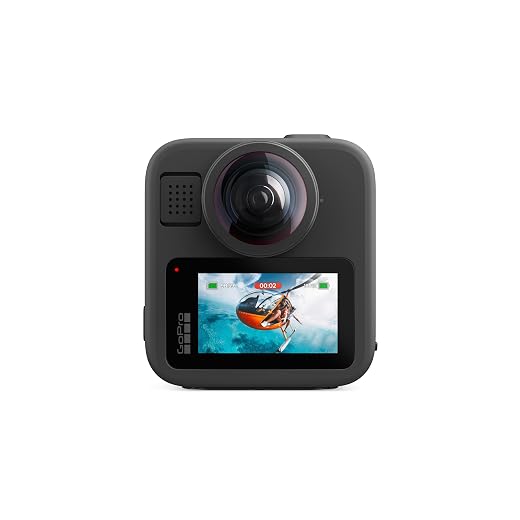
The GoPro MAX is not the best 360 vlogging camera on pure image quality in 2026, but it still has a role for creators who already own a collection of GoPro mounts and find the camera secondhand at the right price. Its 5.6K 360 capture, HyperSmooth stabilization, and dual-screen design were impressive when it launched, and they remain usable for casual 360 experiments.
Its biggest advantage is compatibility. If your existing vlogging workflow uses GoPro helmet mounts, chest harnesses, handlebar mounts, and clamps, the MAX slots into the kit without replacing anything. That is a practical saving that can matter more than raw resolution for a creator with years of accessories already in a drawer.
However, newer Insta360 models are easier to recommend for most people. They offer higher-resolution 360 footage, better low-light results, more mature AI reframing, and a cleaner invisible selfie-stick experience. Buy the GoPro MAX because you are already a GoPro user or because you found a cheap used unit—not because you expect it to lead the category today.
Pros
- Compatible with GoPro mounts and accessories
- Durable waterproof action-camera build
- HyperSmooth stabilization for active use
- Dual screens improve basic camera control
- Often available at an attractive used price
Cons
- Lower-resolution 360 video than newer rivals
- Weak low-light performance by current standards
- Editing tools are less refined than Insta360’s
- No compelling reason to buy new over newer models
Best Compact and Pocket Vlogging Camera
The best compact vlogging camera is DJI Osmo Pocket 3 because it gives creators a large sensor and mechanical stabilization in a pocket-size package. It is not an action camera in the strict sense, but it produces more polished walk-and-talk video than almost any rugged action cam when conditions are calm.
For a compact backup camera, the Pocket 3 is hard to beat. It is light enough to carry every day, fast enough to pull out for a quick introduction, and good enough in low light that it can handle the dinner or nightlife part of a travel vlog without turning everything into noise.
Best Tiny Hands-Free Vlogging Camera
The Insta360 GO 3S is the best tiny hands-free vlogging camera for creators who want to show what they are doing without holding a camera at all. It is less about cinematic image quality and more about getting natural POV footage that would be awkward or impossible with a larger device.
Insta360 GO 3S – 128 GB White 4K Tiny Portable Vlogging Camera, Hands-Free POVs, Mount Anywhere, Stabilization, 140 Min Battery Life, 10m Waterproof, Apple…
Insta360 GO 3S: Best Hands-Free POV Vlogging Camera
The Insta360 GO 3S is the camera to buy when carrying a normal action camera feels like too much. It is tiny, magnetic, wearable, and easy to place on a shirt, hat, pendant, bike frame, dashboard, or small mount. That makes it ideal for daily vlogs, cooking clips, workouts, family moments, behind-the-scenes footage, and travel content where holding a camera would spoil the moment.
The small body means you can capture angles that look more natural than handheld footage. Mount it on your chest while making coffee, wear it while cycling through a city, or place it on a shelf while you pack for a trip. The footage feels immediate because the camera is part of the activity rather than something you stop to operate.
The compromises are obvious: it cannot match a full-size action camera for low-light performance, battery runtime, sound, or image detail. It is also not the camera I would use as the main device for a professional YouTube vlog. Instead, it is a brilliant B-camera, an easy POV tool, or the best choice for creators who value spontaneity more than technical perfection.
Pros
- Extremely small and lightweight
- Magnetic mounting enables hands-free POV shots
- Great for daily life, workouts, cooking, and travel moments
- Simple app editing workflow
- Useful Action Pod screen for remote control and playback
- Easy to keep with you all day
Cons
- Smaller sensor limits low-light quality
- Shorter battery life than full-size cameras
- Built-in audio is basic in noisy environments
- Not designed for high-impact professional action work
GoPro vs DJI vs Insta360 for Vlogging: Brand-Level Comparison
GoPro is best for hard action and mounting flexibility, and DJI is strongest for low-light vlogging, front-screen usability, and audio integration, while Insta360 is the best fit for creators who want flip-screen shooting, AI-assisted editing, or 360 reframing. The best brand is the one that matches how you record, not the one with the longest spec list.
| Brand | Best for | Main strengths | Main limitation |
|---|---|---|---|
| GoPro | Extreme sports and mounted POV | HyperSmooth, rugged bodies, huge mount ecosystem, 5.3K video | Self-framing and premium audio need accessories |
| DJI | Travel, walking, and low-light vlogs | Larger sensors, front screens, wireless mic ecosystem, Pocket 3 gimbal | Smaller third-party mount ecosystem |
| Insta360 | Solo creators and distinctive social content | Flip screens, AI editing, 360 reframing, invisible selfie stick | Some formats require more editing and careful handling |
GoPro HERO13 vs DJI Osmo Action 6 vs Insta360 Ace Pro 2: Flagship Showdown
For flagship vlogging, choose Insta360 Ace Pro 2 if you need a flip screen and strong low-light footage, DJI Osmo Action 6 if you want dual screens and a direct route to great wireless audio, or GoPro HERO13 Black if your vlog is built around hard action, mounts, and rugged reliability. All three are capable; the right answer depends on the shape of your content.
GoPro HERO13 is the strongest action-first choice. It is the camera to put on a helmet, chest, surfboard, or motorcycle because the mount ecosystem and stabilization confidence are hard to match. DJI Action 6 is the more natural walk-and-talk camera, especially in lower light, because its front display and microphone options reduce friction. Ace Pro 2 is the most creator-friendly hybrid, offering a flip screen for self-framing and a large sensor for indoor and evening scenes.
Best Action Camera for Vlogging Under $400 / Under $500
Under $400, the best options are usually discounted DJI Osmo Action 4, GoPro HERO11 Black, Insta360 X3, or an older GoPro HERO12 Black. Under $500, DJI Osmo Action 5 Pro and Insta360 Ace Pro 2 sale bundles become realistic choices, depending on current promotions and what accessories are included.
Do not judge value by body price alone. A cheap action camera that needs a cage, mic adapter, spare batteries, and a new mount can quickly cost more than a slightly pricier kit that already includes the pieces you need. For vlogging, prioritize a usable screen, spare battery plan, and audio solution before paying extra for a resolution mode you may never use.
Best Action Camera Accessories for Vlogging
The most useful action camera accessories are a compact tripod or grip, spare batteries, a fast microSD card, an external microphone, and a small protective case. If you vlog outdoors, add a windscreen, a clip mount, and a way to stabilize the camera while speaking to it.
- Compact tripod or grip: Better for talking clips, hotel-room updates, and time lapses
- External wireless microphone: Essential for clear speech outdoors
- Spare batteries: More useful than chasing maximum resolution
- Fast microSD cards: Prevent recording errors during 4K, 5.3K, and 360 capture
- Chest and helmet mounts: Best for cycling, skiing, hiking, and active POV sequences
- Protective case or sleeve: Important for 360 cameras and gimbal cameras
- Underwater housing: Necessary for serious scuba work beyond a camera’s native waterproof rating
FAQs: Best Action Camera for Vlogging
Which action camera is best for vlogging?
Insta360 Ace Pro 2 is the best all-round action camera for vlogging because its flip screen, larger sensor, useful stabilization, and editing tools make solo filming straightforward. Choose DJI Osmo Action 6 if front screens and wireless microphone integration matter more.
Is GoPro HERO13 good for vlogging?
Yes, especially for adventure vlogs, mountain biking, skiing, surfing, and helmet- or chest-mounted footage. It is less convenient than a flip-screen camera for direct-to-camera clips and usually benefits from an external microphone setup.
Which action camera has the best low-light performance for vlogging?
DJI Osmo Action 6 and Insta360 Ace Pro 2 are the strongest choices for low-light vlogging because their larger sensors and processing handle dim scenes better than older action cameras. DJI Osmo Pocket 3 is even better for low-light handheld footage when waterproofing is not required.
Which action camera is best for travel vlogs?
DJI Osmo Pocket 3 is best for city walks, food content, and talking-to-camera travel videos, while Insta360 Ace Pro 2 is better for waterproof adventure travel. GoPro HERO13 is the better choice if your trip revolves around action sports and mounts.
Which action camera is best for audio and wind noise reduction?
DJI Osmo Action 6 is the easiest action camera to pair with a strong wireless microphone setup. For serious outdoor dialogue, use an external mic regardless of camera brand; built-in wind reduction can help but cannot replace proper audio gear.
Is a used GoPro HERO12 or HERO11 still good for vlogging?
Yes. HERO12 is a capable discounted option for creators with existing GoPro accessories, while HERO11 is excellent for creators who want 8:7 capture for easy vertical and horizontal crops. Both are strongest in daylight and action-focused content.
Which action camera is best for 360 vlogging?
Insta360 X5 is the best 360 vlogging camera because it records every direction, supports AI reframing, and produces the invisible selfie-stick viewpoint. Insta360 X4 is a more affordable alternative for creators who primarily shoot in daylight.
GoPro vs DJI vs Insta360: which brand is best for vlogging?
GoPro is best for rugged mounted action, DJI is best for low-light and audio-friendly travel vlogging, and Insta360 is best for solo creators who want a flip screen, AI editing, or 360 footage. Choose based on your primary shooting style rather than brand loyalty.


